When the arrows point nowhere, I use a notebook sketch, a creek-check, and a short out-and-back to lock in the right tread.
Sketch the junction in your notebook before you touch your phone
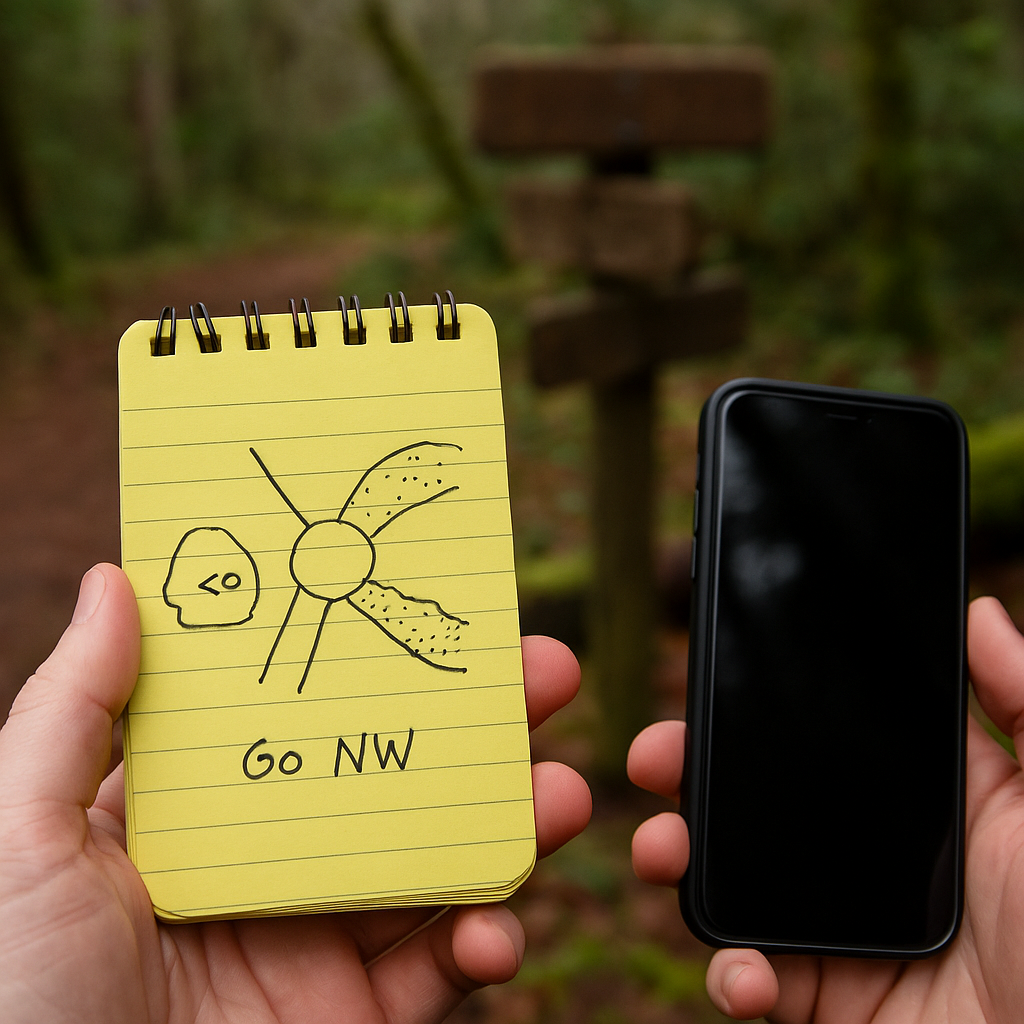
I started doing this after one of those junctions where there are three wooden posts, two faded arrows, and a social trail that looks way more inviting than the actual route. The temptation is always the same: unlock phone, stare at the blue dot, spin in a circle, and somehow make it worse. Now I pull out a tiny Rite in the Rain notebook and draw what I'm standing in. Nothing artistic. Just a circle for the junction, three or four lines for the exits, and two details that won't change in ten minutes: the big boulder on the downhill side, the rotting log with the bright green moss, the switchback that starts immediately vs the path that stays flat for a beat.
Then I add one hard number from my route plan. Not a whole essay, just something like: "We should be heading NE" or "the next mile should climb." If I've got a paper map, I glance at it once and write the direction as a quick arrow. If I'm using Gaia GPS or AllTrails, I still don't zoom and pan yet. I just look at the phone's compass heading for two seconds, write it, and lock the screen again. The sketch keeps me honest, because the next ten minutes are usually the dangerous part: you walk 200 yards, the tread looks good, and your brain starts defending the choice.
Here is the payoff. When you realize you're wrong (and you will, sometimes), you can walk back and your little sketch makes the junction feel familiar again. You don't have to re-litigate it like it's a brand new puzzle. You can also hand the notebook to a hiking partner and say, "Pick the line that matches this," instead of doing the vague, annoying pointing thing. It sounds simple, but it fixes that specific trails-and-walkthroughs problem where the junction is confusing because everything looks like a trail.
Use the drainage as a truth test, not a destination
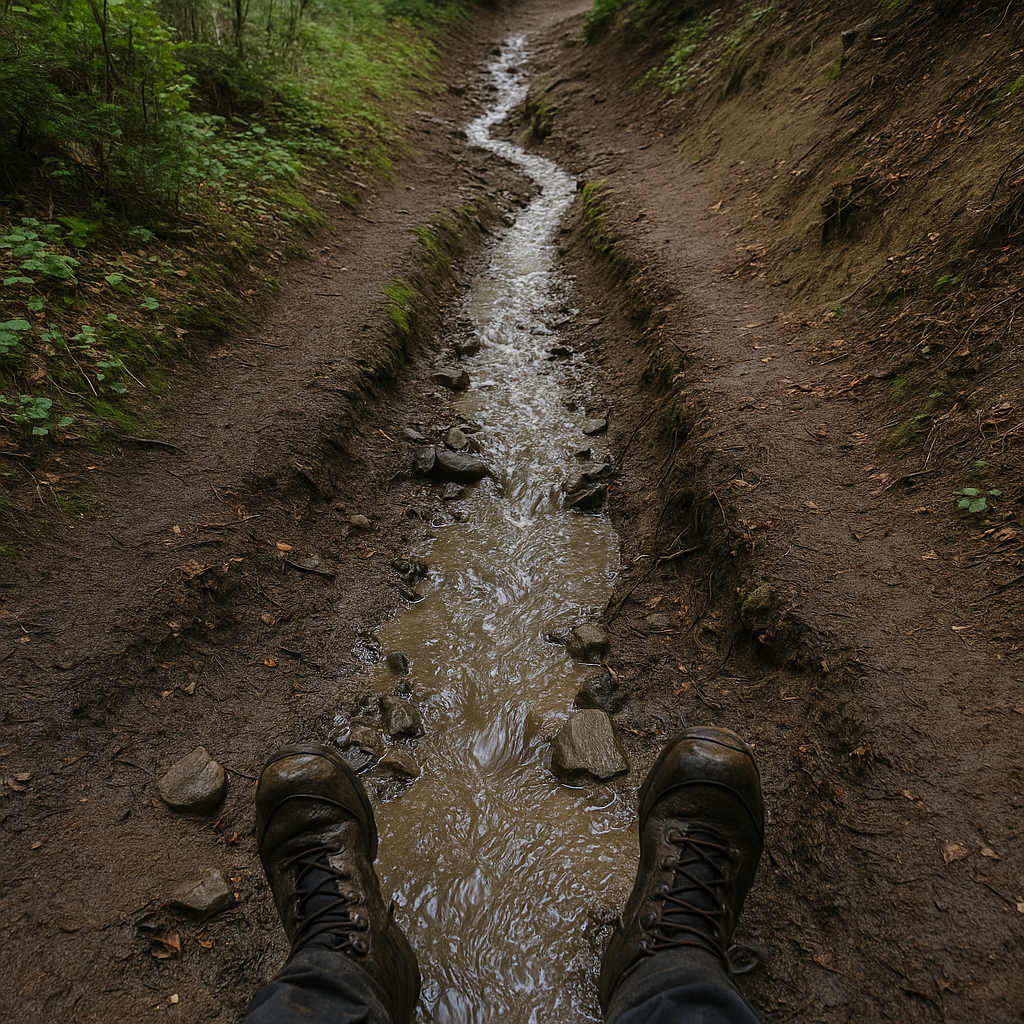
When I'm unsure at a junction, I don't immediately ask, "Which trail looks like the trail?" I ask, "Where is the water trying to go?" Not because I'm planning to follow a creek like it's a handrail (that can turn into a brushy, slippery mess fast), but because drainage is one of the few things out there that doesn't care about signage, cairns, or whether the tread has been maintained this season.
On a topo map, those blue lines and V-shaped contour bends are doing real work. If my planned route is supposed to stay on the west side of a drainage and contour above it, and the option I'm considering immediately drops into a gully with water-polished rocks and a little fan of sand at the bottom, that's a clue. Same thing if the route should cross the drainage once and then climb the opposite ridge, but the path I'm on keeps the creek noise on my right shoulder for way too long. You can even do it without pulling up a full map screen. In Gaia GPS, I like the USGS Topo layer; in AllTrails, the basemap is often enough to see the main drainage lines.
This is also where I pay attention to the small, annoying details: wet boot prints in mud going the direction I need, a line of crushed grass where people have been sidehilling to avoid a puddle, that one spot where the tread is slightly crowned and water runs off instead of down the middle. Maintained trails usually try not to become streams. Social trails do not care, and they love the fall line. If the "trail" you're on is basically a water chute with loose pebbles, that's information you can use before you're 800 feet down and arguing with a GPS arrow.
I learned this the hard way on a shoulder-season hike when everything was leaf-covered and the blazes were spaced like a practical joke. The correct route stayed just above a small drainage, and the wrong path dove straight into it. The moment I heard water getting louder and saw the tread turning into a little trench, I stopped pretending it was fine, climbed back to the junction, and took the line that looked less dramatic. The drama was the warning.
Do a deliberate 3-minute out-and-back to confirm the tread
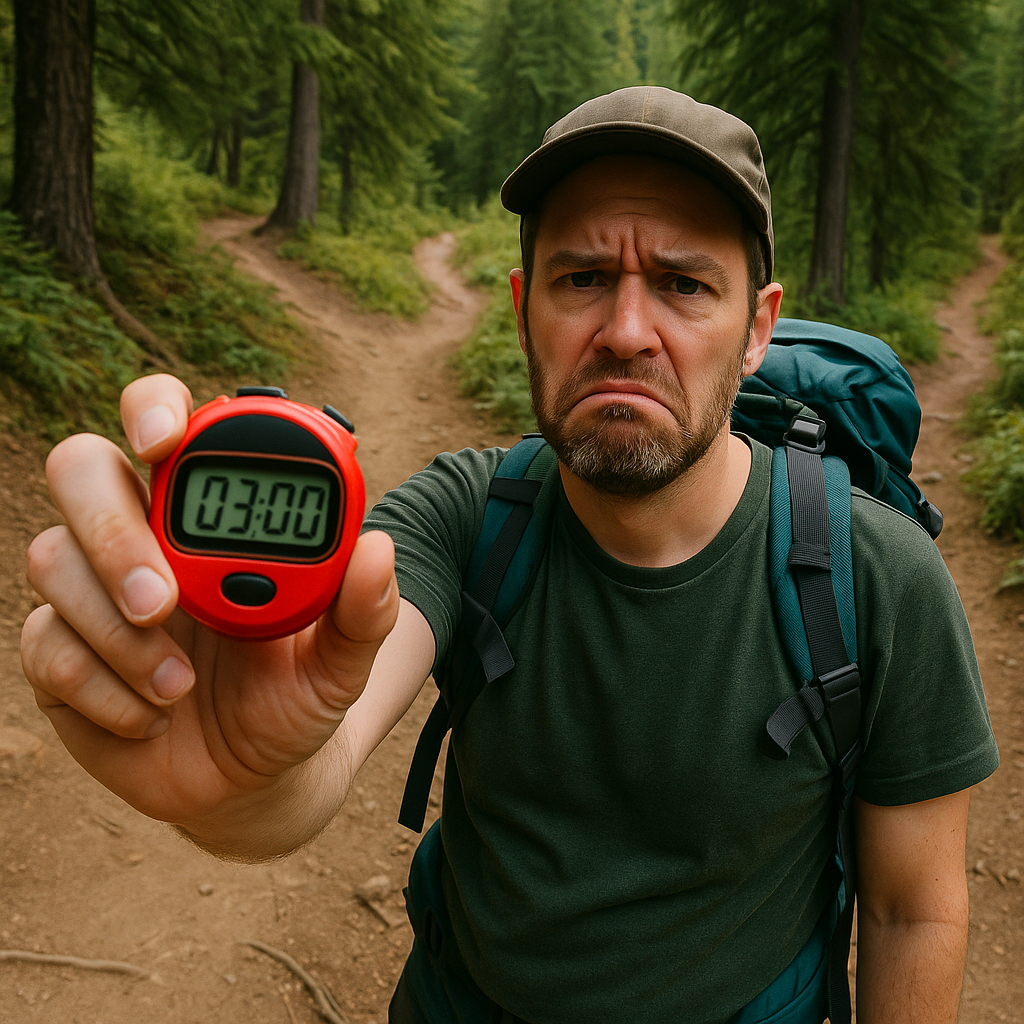
I used to think scouting was wasted time. Then I got older, got a little more protective of my knees, and did enough wrong turns to realize a controlled test is faster than a stubborn commitment. The move is simple: pick the most likely option, set a timer for three minutes, and walk it like you're collecting evidence. At three minutes, you turn around no matter how good it feels. No negotiating with yourself. You walk back to the junction, and you decide with more information than you had two minutes ago.
What I'm looking for on that short probe: does the tread get more defined, or does it immediately braid into multiple options? Do I see fresh cut logs, saw marks, or drainage work (water bars, little rock armoring), or is it just a faint line through duff? Is there confirmation in the form the trail is supposed to take, like a switchback beginning where the map suggests the climb starts? If the route I'm aiming for is a maintained trail, it usually starts behaving like one pretty quickly. If it's a use path, it often stays vague and keeps offering tempting spurs to campsites and viewpoints.
I also watch my GPS track as a breadcrumb, not as a judge. I want to be able to return to the exact junction point cleanly, without widening the area by pacing around. That matters in fragile spots, and it matters for your own sanity. When I get back to the junction, I take ten seconds and compare the probe to my notebook sketch and whatever topo clues I have. If the probe felt wrong, I try the second-best option with the same three-minute rule. It keeps the decision symmetrical. You're not giving one path a full mile to "prove itself" while you give the other thirty seconds.
This works especially well when the junction is noisy with people and opinions. Someone always says, "I'm pretty sure it's that way." Fine. Three minutes. If it is, you'll know because the tread will commit and you'll get a confirming feature (a bridge, a blaze, a signed spur, a clear contour). If it isn't, you only bought three minutes of wrongness, not forty. Then you can walk away from the bad choice without that sinking feeling that you've already invested too much to turn around.